
Our Unique arts curriculum
The mission of the Fine and Performing Arts Departments at Montrose School is to enrich and support each student’s learning experience at Montrose School by providing unique opportunities for personal and intellectual development and self-expression through the study of music, drama, and the visual and performing arts. Through creative exploration, the arts teach skills associated with imagination and invention and can lead students to higher levels of abstract thought. The departments seek fully to engage each student intellectually, emotionally, and physically, with the understanding that the arts are essential to the enlightened life and mind of the individual.

OUR fine & Performing arts OFFERINGS
| art 6 |
|---|
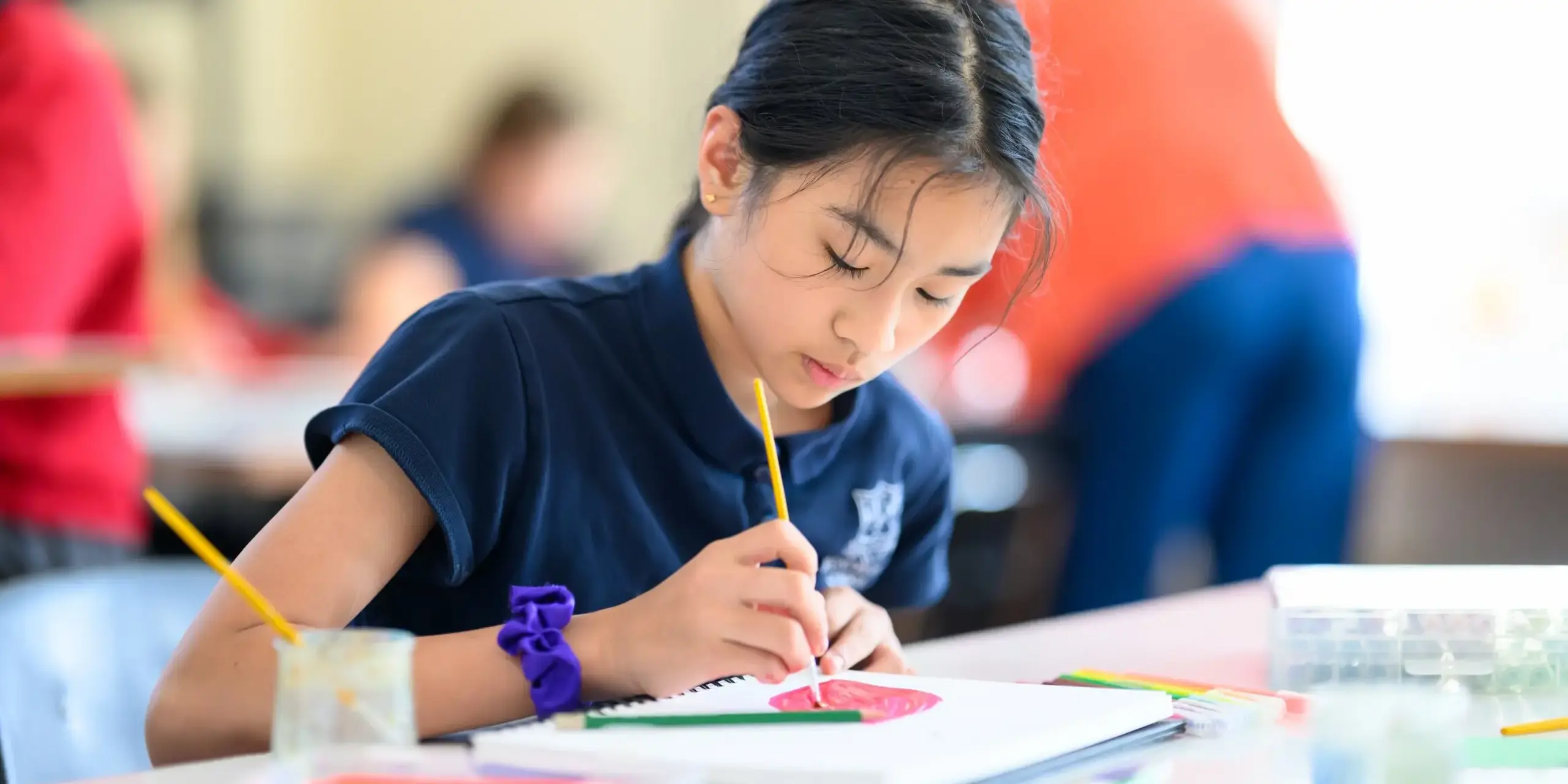
| Art 6 is a course designed to introduce students to art from different countries around the world. Students work with a variety of media and techniques, and develop the ability to make critical judgments about art and to understand historical influences of art from other cultures. This course uses four foundational disciplines to teach concepts and skills through a sequential course of study: art production, art history, art criticism, and aesthetics. |
| art 7 |
| Art 7 is designed to help students develop skills in art making, while also focusing on the elements of art and design. They learn the importance of line, color, texture, space, shape, form and value by studying famous works of art and creating their own artwork to reflect their understanding. Artists past and present are studied to enhance the knowledge needed for these skills. Projects are based on both representational and abstract art, while also connecting to core academic classes. |
| art 8 |
| The focus of Art 8 is to create a series of artworks that culminate into a visual art portfolio. Their portfolio of work is tied to creative writing pieces that students develop in English class, the works of art and writing being reflective and meaningful to their personal story. They are instructed on how to build a personal website and digital portfolio to house and showcase their yearlong collection of art and writing. |
| drawing |
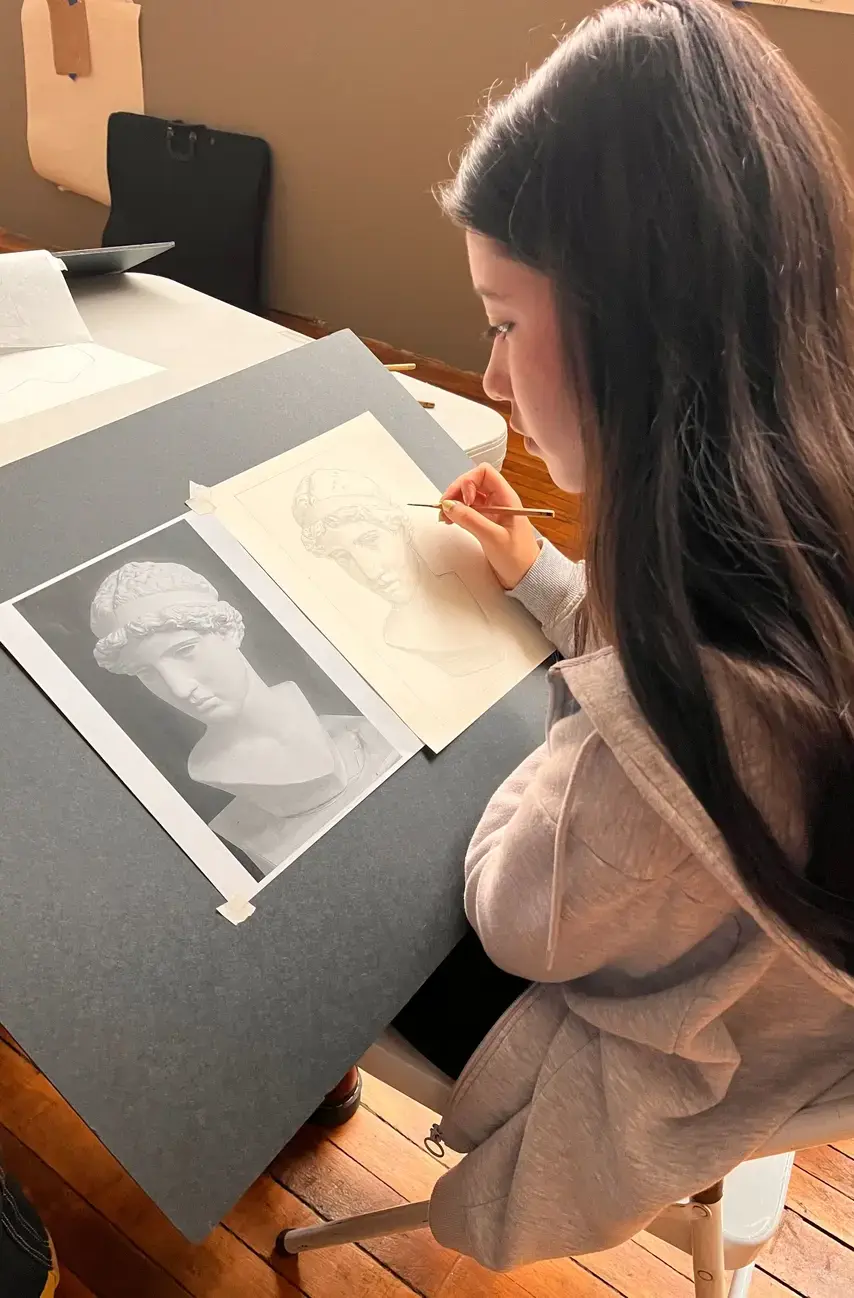
| Drawing is the basic language that an artist uses in order to create any work of art, whether it be painting or making jewelry. This half-credit course will introduce students to the fundamental elements and principles such as line, value and modeling form. A variety of media will be explored including graphite, charcoal, pens and inks. Through direct observation, students will learn how to accurately see and record objects from real life. Individual and group critiques will be held regularly. During the second semester, students will gain a working knowledge of the basic principles of composition. Drawing from direct observation will be emphasized, as skills of proportion and various spatial strategies will be developed, including perspective and foreshortening. This course, which can be taken more than once, is the prerequisite for Painting. |
|
painting |
| This half-credit course will introduce students to the basic techniques and color principles of watercolor and acrylic painting media. Concepts and skills learned will include (but not be limited to): composition, surface exploration, color mixing, underpainting, observational painting, layering, expressive use of paint, and abstraction. Prerequisite: Drawing. Offered to Grade 10 and higher. |
| art portfolio prep honors |
| This honors level intensive studio course is the first of a two-year sequence which will finish with the AP Studio Art 2D Design course. In Portfolio I, students begin (or continue) the process of building a portfolio of works to be submitted to the College Board at the end of the AP 2D Design course for evaluation for an AP score. Students must have strong studio habits and technical skills, and be willing to spend a significant amount of time beyond class periods on studio work. Students will be expected to work semi-independently at a rigorous pace on assignments that will build their skills in craftsmanship, design and narrative. Their work will be exhibited at the end of the year. Prerequisites: successful completion of Drawing and Painting prior to enrollment. Students who took these classes somewhere other than at Montrose must show assignments completed in these courses to the instructor to receive permission to enroll. |
| AP 2D Art and design |
| The AP 2D course is intended for highly motivated students who are seriously interested in the study of art and design. The course is taught at a more rigorous pace than previous high school art classes. To successfully prepare an AP portfolio, students need to commit at least twice as much time outside of class creating art as they do during normal class - at least five hours outside of class per week. This course is for students who demonstrate commitment, time-management and artistic accomplishment when enrolled. It is expected that students have a high level of execution and show a high skill set within their work, all while learning how to develop their own personal artist ‘voice’. Successful completion of Drawing, Painting and Portfolio I are prerequisites to this course. This course emphasizes making art as an ongoing process that involves the student in informed and critical decision making at all times, according to their own individual inquiry. Students create a portfolio of work to demonstrate inquiry through art and design and development of materials, processes, and ideas over the course of a year. Portfolios include works of art and design, process documentation, and written information about the work presented. In May, students submit portfolios for evaluation based on specific criteria, which include skillful synthesis of materials, processes, and ideas and sustained investigation through practice, experimentation, and revision, guided by questions. |
| elements of science & art |
| This upper level course offers a cross-disciplinary exploration, combining art-making with elements and principles found in the natural world. Students will create inspired works of art in the studio to highlight scientific concepts which will connect and extend their knowledge in the scientific field of study. They will refine their observation skills, explore patterns and themes through processes and materials. Subject, interpretation, style, context and emotion will be the key elements used to analyze works of art. Through this cross-disciplinary course students will dive deeper in understanding the common ground between science and art. By bridging the gap between these areas of study, students will develop exciting artistic possibilities for their artwork. |
| studio & renaissance art |
| This upper level course combines art-making with the study of art history, highlighting Renaissance artists from Italy. Students will create inspired works of art in the studio, using perspective, balance, harmony, and specific stylistic qualities from the Renaissance. They will refine their direct observation skills and explore genres and themes through processes and materials. Subject, interpretation, style, context and emotion will be the key elements used to analyze significant works of art by artists such as Giotto, Sandro Botticelli, Ghiberti, Fra Angelico, Masaccio, Leonardo da Vinci, and Michelangelo. |
| choreography |
| This half-credit course offers students the opportunity to experience expressive movement in an open, friendly environment, suitable for novice, intermediate, and advanced dancers. A survey course, this class will cover a wide range of dance styles and techniques through combinations that exercise the brain as much as the body. This studio class will commence with a daily warm-up, followed by foundational and technical exercises, and conclude with a dance combination -- often building on dances begun in previous class periods. Students will practice the art and artistry of the form, as well as learning to grow individually while moving as an ensemble. A pair of soft-soled dance shoes (ballet, jazz, Irish, etc.) are required, as are form-fitting clothes that allow full range of movement and display body lines (non-baggy athleisure wear, fitness attire, etc.). |
| middle school chorus 6 |
| 6th graders take choir as a cohort apart from their 7th and 8th grade peers to establish foundational knowledge of music literacy and vocal technique. In addition, students study music from around the world in short lessons and interactive signature experiences. 6th graders participate in two concerts a year that are required for all students. |
| middle school chorus 7/8 |
| Students in 7th and 8th grade participate in a combined choir that reviews foundations from 6th grade and then builds on them. Students practice music literacy regularly. In addition to the music literacy curriculum, students also study music history and American music history over their two years in the course. Students in this course have opportunities for leadership positions in section leaders. This choir performs twice a year in our school concerts. |
| middle school chamber choir |
| Middle School Chamber Choir is a non-auditioned elective group. Students in this class enroll because of their desire to learn more challenging music and do accelerated music theory. Though not auditioned, students uphold high performance expectations. Students in this course have opportunities for leadership positions in section leaders. This choir performs twice a year in our school concerts. |
| middle school tone chimes |
| Tone chimes is a one-semester instrumental ensemble course taken in both 7th and 8th grade. In this course, students apply music literacy from their choir classes to rhythm reading for their assigned instrument. |
| upper school chorus |
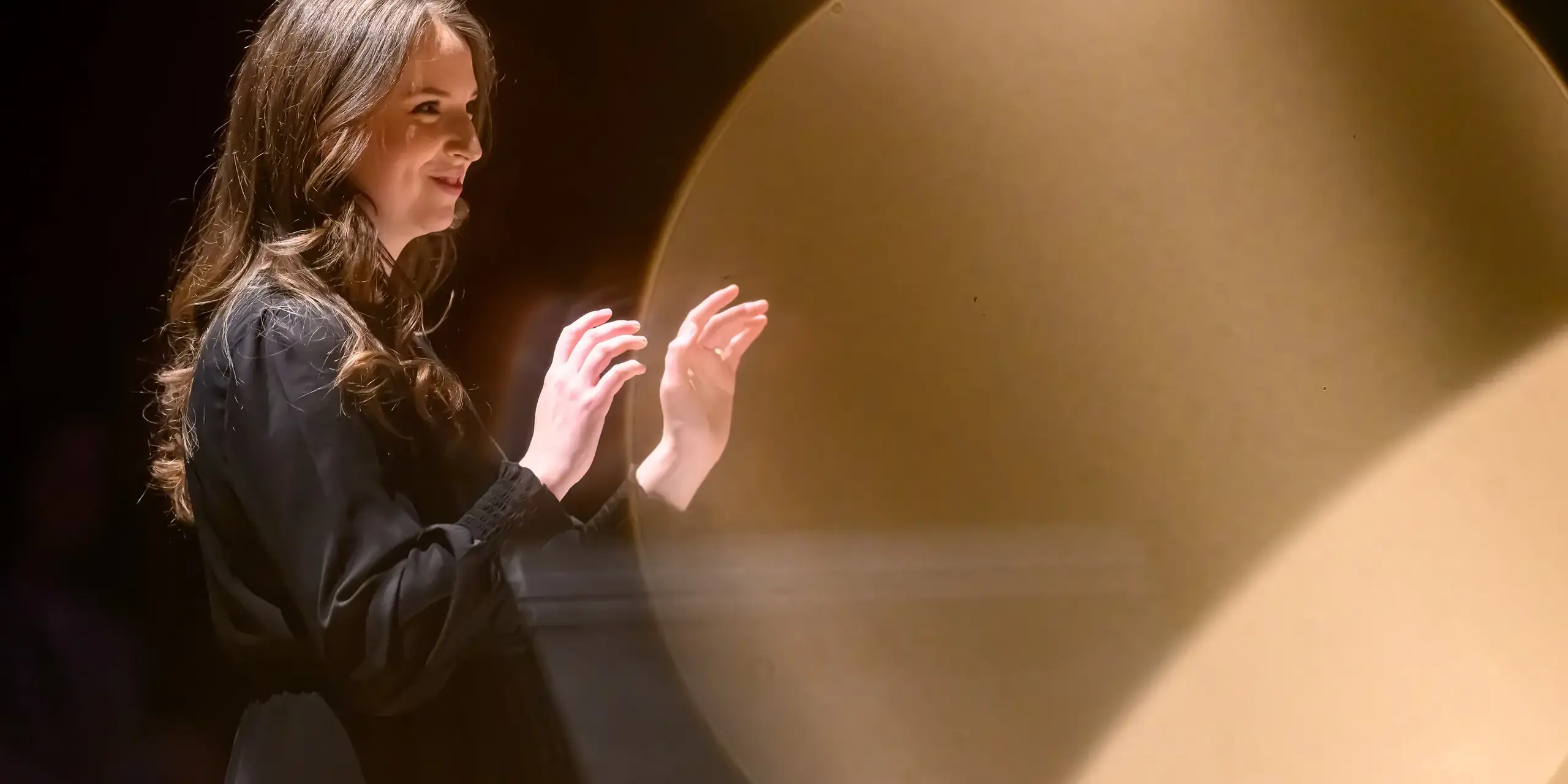
| Upper School Chorus is a half-credit course that provides girls with an interest in singing and performing an opportunity to develop their vocal skills and to increase their awareness of choral literature and performance practice. The Chorus prepares a wide range of challenging repertoire in two, three or four part harmony, representative of all styles and periods, from Renaissance to contemporary, often unaccompanied. Students in this course often have input for the types of music they would like to explore for their performances. Vocal technique and principles of good singing are studied through the music prepared for performances. The chorus presents annual concerts twice yearly, and has been invited to sing at Mass and on special occasions. Singers are expected to participate in all performances, memorize concert repertoire, and acquire a working knowledge of basic rhythm, solfège, musical terminology and analysis through score study. Careful attention is given to the relationship between text and music. Occasional assessments are required to review course material or repertoire preparation. |
| upper school handbells |
| The members of the handbell choir focus on learning a variety of ringing techniques while building upon their pre-requisite musical literacy skills. These pre-requisite skills include the ability to identify notes in both the treble and bass clefs, to execute simple rhythms accurately, as well as to understand and use basic music terminology. Each ringer will assume command of one unique and independent ringing position. In addition to mastering their individual parts, students will grow to appreciate the importance of their responsibilities as collaborative members of an ensemble. Rehearsal time will be spent preparing for a variety of performance opportunities, including Lessons & Carols in December and a spring concert. Participation in any and all performances is required. This is a .25 credit course. |
Imagine yourself here . . .
Stepping into Montrose’s art studio, dance studio, or stage means picking up the tools of your trade and refining the habits of excellent craftsmanship.
- As an artist, you will receive close support from practicing artists as you develop technical mastery and expressive creativity, culminating in a theme-driven portfolio for AP 3D Studio Art. Select students also study with a local artist on Saturdays.
- As a musician, you will build choral skills and play tone chimes and handbells, with opportunities to join a cappella groups and the chamber music club. Advanced singers have opportunities to audition for Junior, Senior, and All-State District Festivals.
- As a dancer, you can share your talents in Choreography class and audition for the Middle School and All School Musicals.
- As a thespian, you can take Theatre Production, audition for two to three productions plus a one-act play, perform in our annual Merrie Month of May Shakespeare Festival, and compete in theatrical categories on the Speech & Debate Team.
Guided by teachers trained in the fine and performing arts, you will perfect your craft for your own enrichment or for college study, cultivating what Aristotle called techne: “the rational habit concerned with making.”
Fine & Performing Arts Faculty
M.A., Character Education, University of Birmingham (UK)
M.A., Character Education, University of Birmingham (UK)
M.A., Character Education, University of Birmingham (UK)