


Our Unique MATH curriculum
The mission of the Mathematics Department at Montrose School is to provide for all students the opportunity and support necessary for them to learn significant mathematics with depth and understanding; to help students make, refine and explore conjectures on the basis of evidence and use a variety of reasoning and proof techniques to confirm or disprove those conjectures; to assist students in becoming flexible and resourceful problem solvers; to teach them to utilize knowledge of a variety of mathematical topics; to approach problems from different mathematical perspectives and represent the mathematics in different ways; and to equip students to communicate their mathematical ideas and results both orally and in writing.
OUR MATH DEPARTMENT OFFERINGS
| grade 6: math 6/6 advanced |
|---|
|
Math 6 builds upon prior math knowledge and prepares students for success in future middle school and high school math courses. Students work collaboratively in teams on rich, meaningful problems and investigations to develop multiple strategies to solve problems and to recognize the connections between concepts. Upon completion of this course, students should be able to complete operations with integers and rational numbers, use percentages and scale factors, simplify variable expressions, solve one variable linear equations, solve word problems, solve problems involving proportional relationships, and calculate area and perimeter of a variety of shapes. In order to improve number sense, students do not use calculators frequently. At the conclusion of the sixth grade math course, students will be placed in Math 7 or Math 7 Advanced. |
| grade 7: math 7/7 advanced |
|
Math 7 encourages students to think logically and to develop their abstract reasoning through independent discovery of mathematics as well as through multi-level problem solving. Students will work independently and with partners on meaningful problems and investigations to develop multiple strategies to solve problems and to recognize the connections between concepts. They study operations with decimals, fractions, and signed numbers; solutions of equations and inequalities using algebra; manipulations of exponents and exponent rules for both positive and negative powers; squared numbers and square roots; graphing linear equations and inequalities on a coordinate plane; solving systems of linear equations; basic geometry; and basic statistics. On a daily basis, students problem-solve, question, investigate, analyze critically, and communicate rigorous arguments to justify their thinking. The course is well balanced among procedural fluency (algorithms and basic skills), deep conceptual understanding (rigorous justifications and proofs), strategic competence (problem solving), and adaptive reasoning (extension and application). At the conclusion of this course, students will be placed in Algebra I CP or Algebra I Honors. |
| grades 8/9: algebra 1 CP |
| Algebra 1 is the first course in a five-year sequence of college preparatory mathematics courses that starts with Algebra 1 and continues through Calculus or Statistics. The Algebra 1 CP course aims to deepen and extend student understanding built in previous courses by focusing on developing fluency with solving linear equations, inequalities, and systems. These skills are extended to solving quadratic equations, exploring linear and quadratic functions graphically, numerically, symbolically and by using regression techniques to analyze the fit of models to distributions of data. On a daily basis, students: use problem-solving strategies, ask questions, investigate, analyze critically, gather and construct evidence, and communicate rigorous arguments to justify their thinking. The course balances work in procedural fluency (algorithms and basic skills), deep conceptual understanding, strategic competence (problem solving), and adaptive reasoning (extension and application). Students will use Desmos graphing calculator to enhance their understanding of the topics taught in this class. Students entering Montrose in 9th grade who demonstrate readiness for Algebra 1 will be required to take both Algebra 1 and Geometry concurrently before entering Algebra 2 in their sophomore year. |
| grades 8/9: algebra 1 Honors |
| Algebra 1 is the first course in a five-year sequence of college preparatory mathematics courses that starts with Algebra 1 and continues through Calculus or Statistics. Algebra 1 Honors moves at a quick pace and aims to deepen student understanding of concepts taught in previous courses such as slope, linear functions, domain and range, solving equations, properties of exponents, and systems. Students in Algebra 1 Honors will extend these skills to solving absolute value and quadratic equations, exploring linear, absolute value, quadratic, and exponential functions graphically, numerically, and symbolically. On a daily basis, students: use problem-solving strategies, ask questions, investigate, analyze critically, gather and construct evidence, and communicate rigorous arguments to justify their thinking. The course is well balanced among procedural fluency (algorithms and basic skills), deep conceptual understanding, strategic competence (problem solving), and adaptive reasoning (extension and application). Students will use Desmos graphing calculator to enhance their understanding of the topics taught in this class. Students entering Montrose in ninth grade who demonstrate readiness for Algebra 1 will be required to take both Algebra 1 and Geometry concurrently before entering Algebra 2 in their sophomore year. |
|
grade 9: geometry CP |
| Geometry CP aims to formalize and extend the geometry that students have learned in previous courses. After learning the basic definitions, postulates and theorems of Euclidean geometry, students study the principles of logical reasoning. Real-life applications illustrate the many uses of geometry. This course reviews and applies key Algebra 1 skills and concepts, particularly in the study of plane and solid geometry. Topics covered in this course include, parallel and perpendicular lines, transformations, triangle congruence and similarity, right triangle trigonometry, quadrilaterals, circles, and three-dimensional solids. In particular, the study of right triangle trigonometry builds an essential foundation for the study of unit circle trigonometry in Precalculus. Students are encouraged to develop a conceptual understanding of the postulates and theorems of geometry rather than simply memorize them. They also focus on mastering the proper and concise use of mathematical terminology. TI-84 or TI-84 Plus Calculator required. |
| grades 8/9: geometry honors |
|
Geometry Honors moves at a fast pace and aims to formalize and extend the geometry that students have learned in previous courses. After learning the basic definitions, postulates, and theorems of Euclidean geometry, students study the principles of logical reasoning. They sharpen their deductive reasoning skills throughout the year by writing formal two-column proofs as well as paragraph proofs. Real-life applications illustrate the many uses of geometry. This course incorporates key Algebra 1 skills and concepts, particularly in the study of plane and solid geometry. Topics covered in this course include parallel and perpendicular lines, transformations, triangle congruence and similarity, right triangle trigonometry, quadrilaterals, circles, and three-dimensional solids. In particular, the study of right triangle trigonometry builds an essential foundation for the study of unit circle trigonometry in Precalculus. Students are encouraged to develop a conceptual understanding of the postulates and theorems of geometry rather than simply memorize them. They also focus on mastering the proper and concise use of mathematical terminology. TI-84 or TI-84 Plus Calculator required. |
| grade 10: algebra 2 cp |
| Students in Algebra 2 CP will develop their algebraic skills learned in previous courses and apply them to real-life problems. Students will work on building their math fluency in areas of accuracy, automaticity and efficiency. Emphasis will be placed on engaging in dialogue with classmates aimed at clarifying how and why the algebra works instead of just repeating steps from rote. While recalling facts is important, students at this level go deeper: they explain their ideas as well as apply algebraic concepts to solve problems. Topics covered in this course include solving and graphing linear and quadratic functions and inequalities; solving and graphing rational equations and functions; procedural fluency working with polynomial operations and functions; understanding and applying properties of exponents as well as understanding the connections between powers, roots and radicals to solve more complex equations. Students will use graphing calculators to enhance their understanding of the topics taught in this class. TI-84 or TI-84 Plus Calculator required. |
| grades 9/10: algebra 2 honors |
| Algebra 2 Honors is a fast-paced class, designed to help students build a strong understanding of various types of functions and their characteristics. Students will continue to build upon their skills learned in previous courses which include using mathematical terminology and symbols both orally and in writing; reading charts, graphs, and diagrams; analyzing and solving equations and word problems numerically, graphically and algebraically; and applying concepts in new situations to solve problems. The class offers a wide variety of challenging problems that build on students’ prior knowledge of the subject to develop logical thinking and reasoning skills. Topics covered in this course include solving and graphing linear and quadratic functions and inequalities; solving and graphing rational equations and functions; solving and graphing exponential and logarithmic equations and functions; procedural fluency working with polynomial operations and functions; understanding and applying properties of exponents as well as understanding the connections between powers, roots and radicals to solve more complex equations. Students will learn to use graphing calculators as well as Desmos to enhance their understanding and solve problems. TI-84 or TI-84 Plus Calculator required. |
| grade 11: Precalculus CP |
| Precalculus: Functions, Statistics, and Trigonometry CP provides a strong foundation in concepts, techniques and applications needed to succeed in college as well as on standardized tests. This course aims to strengthen students’ quantitative reasoning and problem solving skills as well as help students use tables, graphs and algorithms to interpret, represent and generalize abstract mathematical concepts. Students will deepen and extend their understanding built in previous courses by developing fluency with solving and graphing polynomial, rational, exponential, and logarithmic equations and functions. Students will build on the foundation in right triangle trigonometry from geometry to study trigonometric functions of any angle and the unit circle. They will also extend this knowledge to graph trigonometric functions with transformations. The final third of the course will focus on the basic understanding of descriptive and inferential statistics. Emphasis is on application, not memorization of formulas, as well as the interpretation of results in real-life contexts. Students will use graphing calculators to enhance their understanding of the topics taught in this class. The ability to use a graphing calculator proficiently is necessary for this course. After taking this course in Grade 11, students will take Statistics or Honors Calculus in Grade 12. TI-84 or TI-84 Plus Calculator required. |
| grades 10/11: precalculus honors |
| Precalculus Honors provides a strong foundation in concepts, techniques and applications needed to succeed in Calculus as well as on standardized tests. Precalculus Honors is a fast-paced class where students further develop quantitative reasoning and problem-solving skills and build upon these skills by exploring a wide range of mathematical applications. Emphasis will be placed on finding numerical, graphical and algebraic solutions to problems. Students will extend their understanding of concepts learned in previous courses by delving deeper into problems involving quadratic, polynomial, exponential, logarithmic, and trigonometric equations and functions. New topics including limits, continuity, and basic derivatives will be introduced as well to prepare students for success in future calculus courses. TI-84 or TI-84 Plus Calculator required. |
| grades 10/11: Accelerated Precalculus Honors |
| Accelerated Precalculus provides a strong foundation in concepts, techniques and applications needed to succeed in Calculus as well as on standardized tests. Accelerated Precalculus is a fast-paced class where students further develop quantitative reasoning and problem-solving skills and build upon these skills by exploring a wide range of mathematical applications. Emphasis will be placed on finding numerical, graphical and algebraic solutions to problems. During the first semester, students will extend their understanding of concepts learned in previous courses by delving deeper into problems involving polynomial, exponential, logarithmic, and trigonometric equations and functions. The second semester includes the study of differential calculus including limits, continuity, derivatives, related rates, optimization, and other applications of derivatives. TI-84 or TI-84 Plus Calculator required. |
| Grade 12: statistics CP/Honors |
| This course for seniors is designed to provide a basic understanding of descriptive and inferential statistics and their applications in real-world contexts. Topics covered in this course include data collection and study design, numeric and graphical methods for describing data, the normal distribution, probability principles and simulation techniques to model random phenomena and assess uncertainty, and the use of appropriate statistical methods to draw conclusions and make informed decisions. Emphasis is placed on application and interpretation of statistical concepts rather than the memorization of formulas. Students will use graphing calculators to enhance their understanding of the topics taught in this class. The honors course is open to students who scored 84% or higher in Precalculus Honors or 90% or higher in Precalculus CP. TI-84 or TI-84 Plus Calculator required. |
| Grade 12: AP statistics |
| AP Statistics is an introductory college-level statistics course that introduces students to the major concepts and tools for collecting, analyzing, and drawing quantitative conclusions from data. Students build a strong foundation in probability rules and distributions, which they apply to all of their inference procedures. They explore concepts such as randomness, variation, and uncertainty; sampling distributions and the central limit theorem; hypothesis testing and confidence intervals; and regression analysis and introductory causal inference. This course requires strong writing and reading comprehension skills, and is open to students who scored 90% or higher in Honors Precalculus and students who scored 95% or higher in Precalculus CP. All students in this course will take the AP exam in May. TI-84 or TI-84 Plus Calculator required. |
| grade 12: calculus honors |
| This course for seniors is designed to provide an introductory understanding of calculus topics. The course will begin with a brief overview of prerequisite knowledge for calculus and then cover the calculus content. Topics covered include limits and continuity, the limit definition of the derivative, differentiation, applications of derivatives, and definite integrals and antiderivatives. Throughout the course, a deep conceptual understanding of these topics will be developed and students will learn about the real life applications of the topics covered. Students will use graphing calculators as well as Desmos to enhance their understanding of the topics taught in this class. The foundation in calculus topics provided by this course will prepare students for success in college-level calculus. TI-84 or TI-84 Plus Calculator required. |
| grades 11/12: ap calculus ab |
| AP Calculus AB is a college-level calculus course equivalent to one semester of college calculus. Students in AP Calculus AB investigate both differential and integral calculus and their real-world applications. The course emphasizes a multi-representational approach to calculus in which concepts are expressed geometrically, numerically, analytically, and graphically. All students in this course will take the AP exam in May. This course is open to students who scored a 90% or higher and demonstrated sufficient mastery on the final exam in Precalculus Honors as well as students who have completed Accelerated Precalculus. TI-84 or TI-84 Plus Calculator required. |
| grades 11/12: ap calculus bc |
| AP Calculus BC is a college-level calculus course equivalent to a full year of college calculus. The course covers all the topics as outlined in the curriculum framework described by the College Board. These include differential and integral calculus, as well as infinite series, Taylor Series, and applying calculus to parametric, vector-valued, and polar functions. The structure of the course emphasizes numerical, graphical, analytical and written approaches to problem solving. All students in this course will take the AP exam in May. This course is open to students who scored a 94% or higher and demonstrated sufficient mastery on the final exam in Accelerated Precalculus Honors as well as students who have completed AP Calculus AB. TI-84 or TI-84 Plus Calculator required. |
| grade 12: multivariable calculus |
| Multivariable Calculus is a rigorous course equivalent to a third semester of college-level calculus for students who have completed study of AP Calculus BC. Multivariable Calculus extends concepts from calculus to more than one variable and students will develop their ability to visualize graphs in three-dimensional space as well as use spherical and cylindrical coordinates. Topics covered will include matrices, vectors, parametric curves, partial derivatives, tangent planes, directional derivatives, lagrange multipliers, local and global extrema of functions of several variables, double integrals, triple integrals, and line integrals. Students must demonstrate a high level of mastery of AP Calculus BC in order to be eligible for this course. The class will be weighted as an AP class on the transcript. |
Imagine yourself here . . .
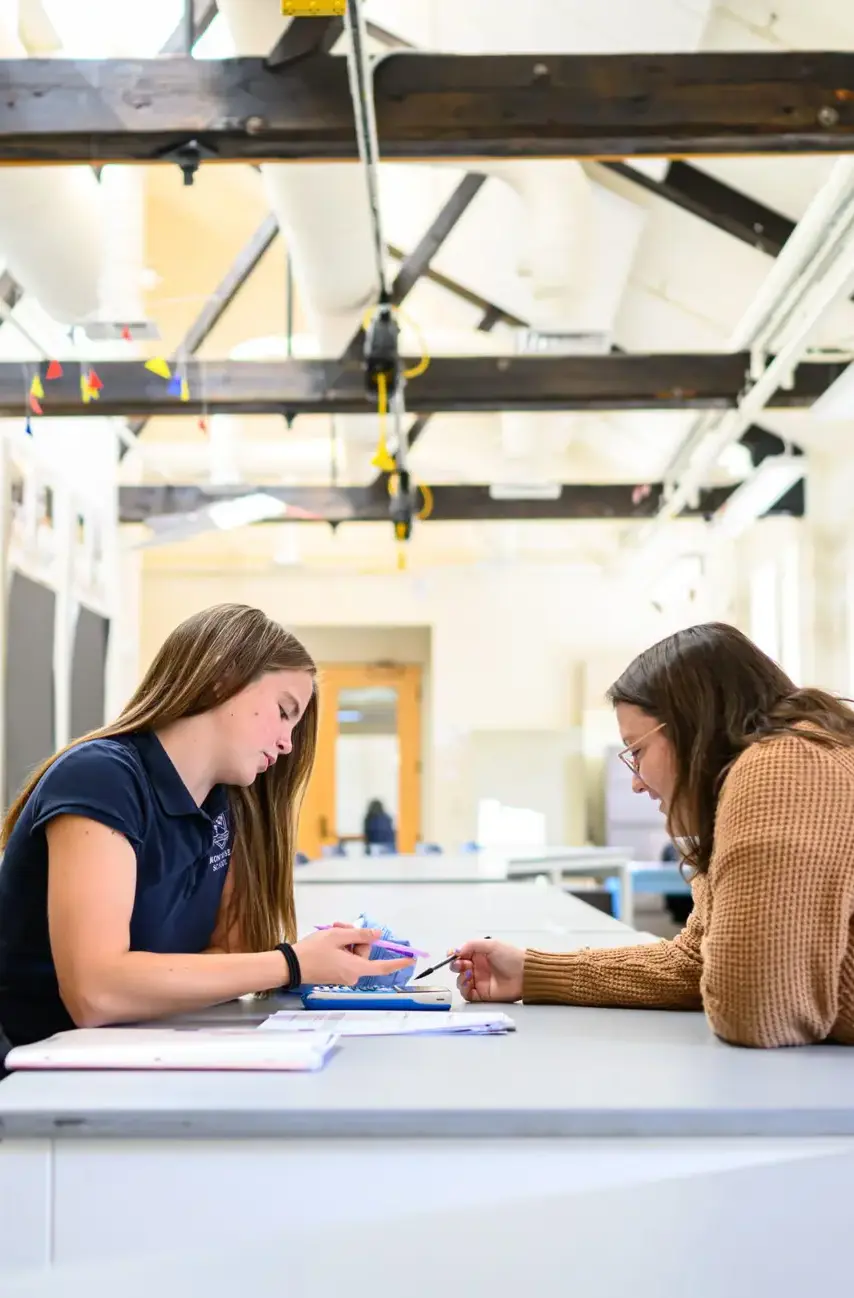
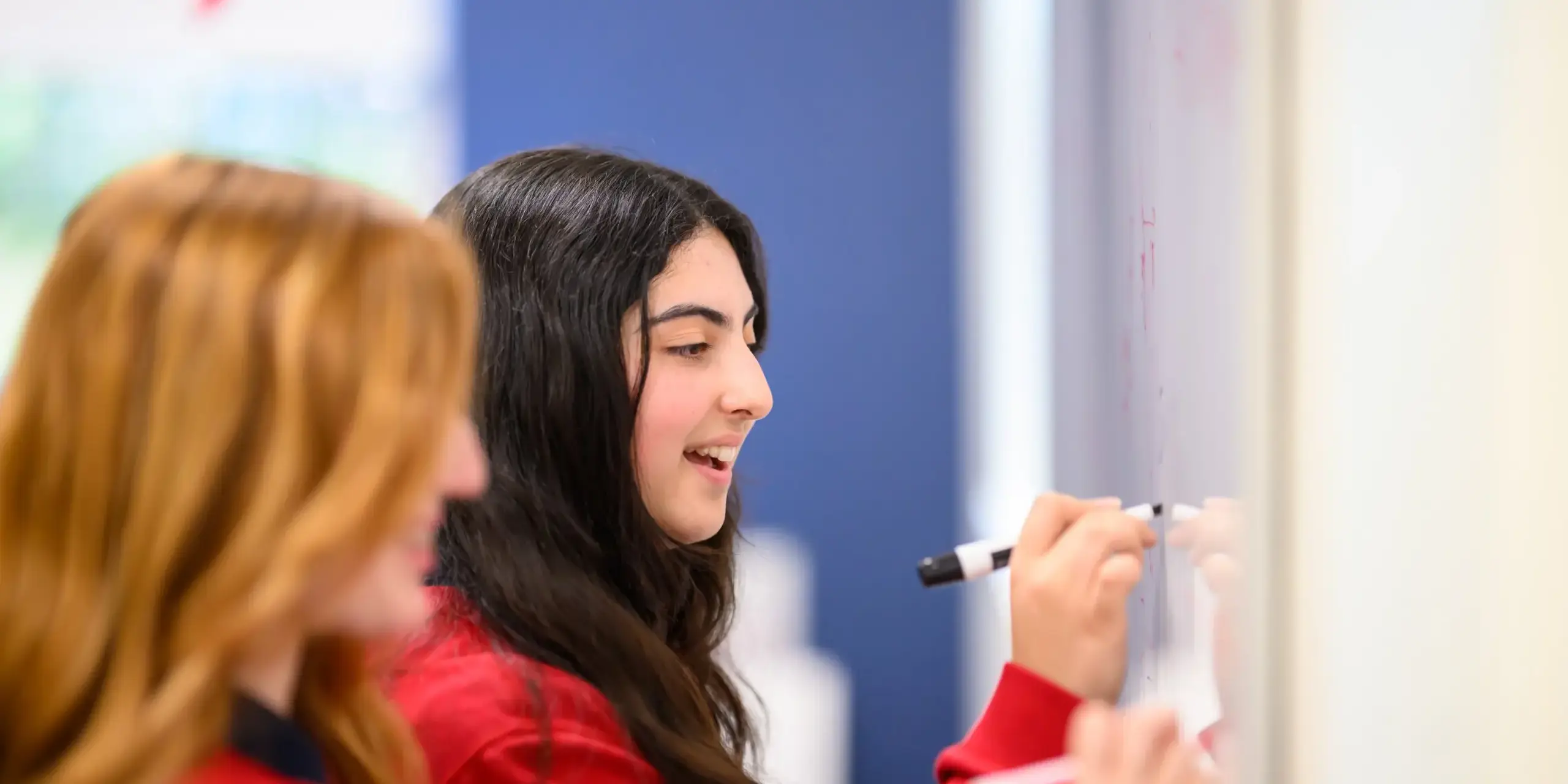
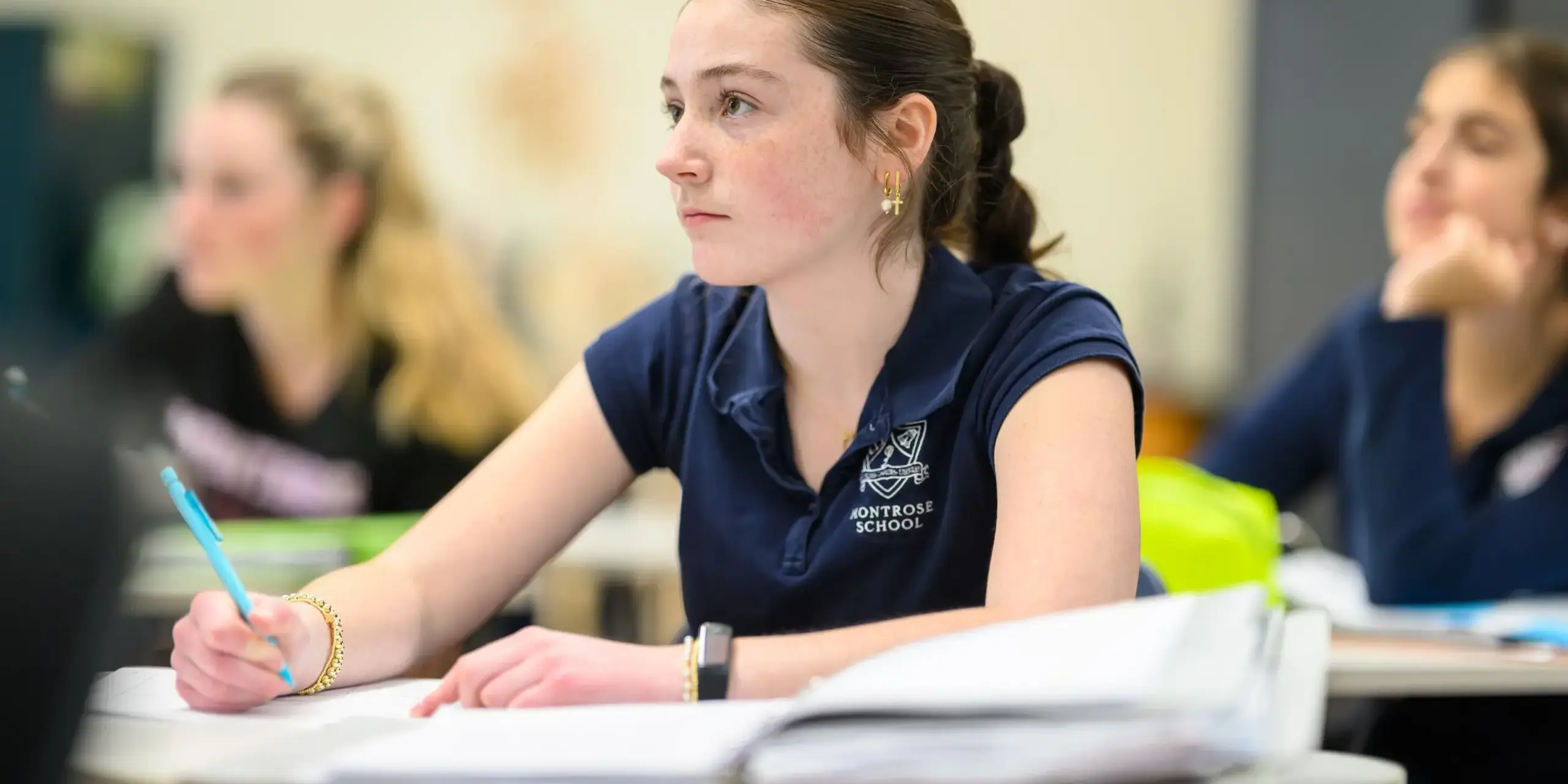
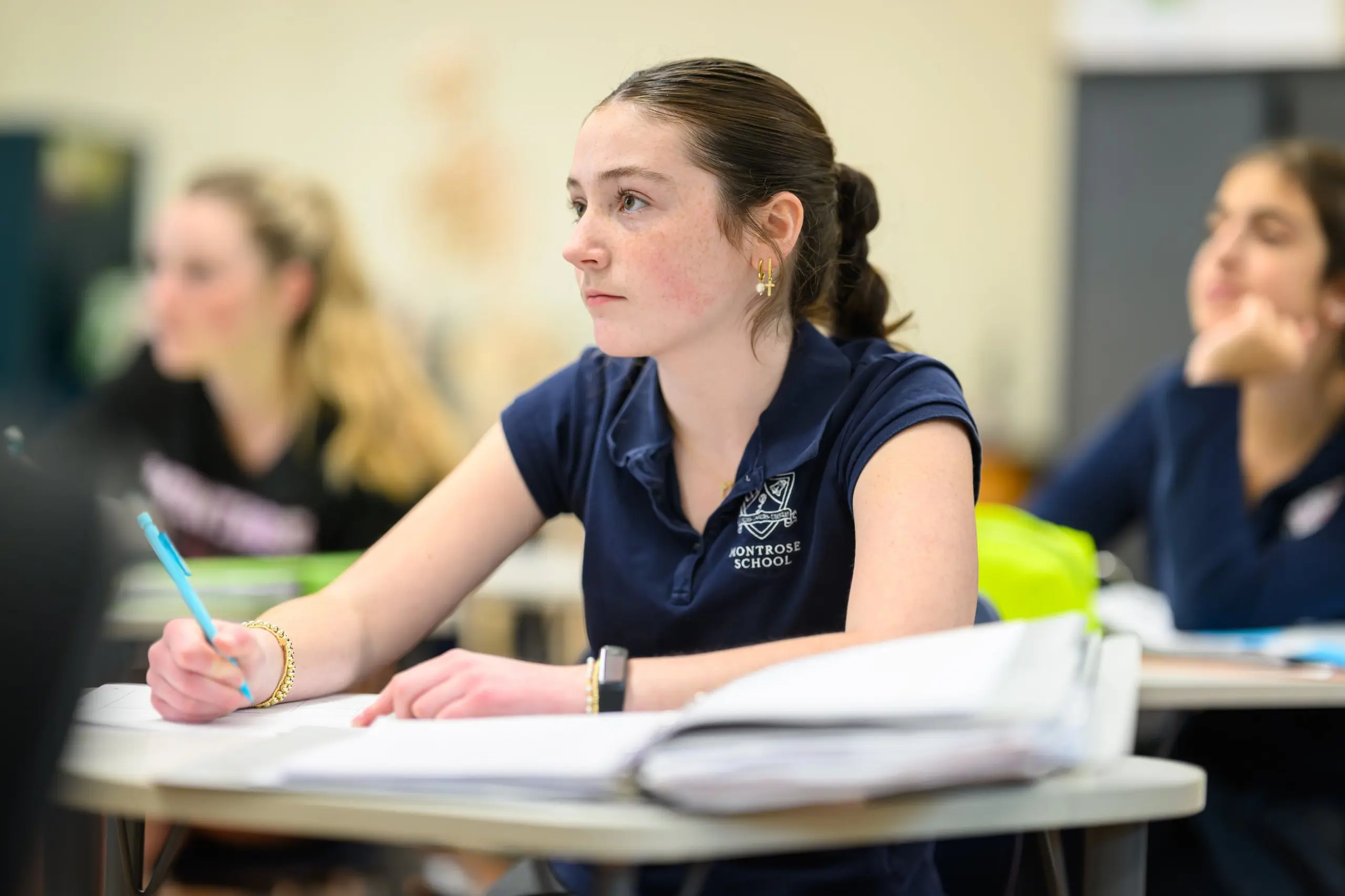
You might do more standing than sitting in your Montrose math class, solving problems with a few classmates at a small whiteboard or modeling your thinking for the class on a large one. You’ll be encouraged to solve problems in different ways and share your reasoning, while your teacher helps you understand the whys and connect different mathematical representations. With plenty of guided practice and encouraging peers, you’ll build flexible thinking and a confident voice.
You’ll be placed in a class that both stretches you and meets your readiness, with scaffolded support and extensive options for acceleration, mixed-grade classes, Advanced Placement, and college-level courses.
As a math student, you will:
- Strengthen quantitative reasoning to understand concepts and their relationships and solve problems in diverse ways.
- Master number sense, understanding the why and how of applying math to real-world situations.
- Sharpen spatial logic to visualize and reason about objects and shapes.
- Think statistically about data, uncertainty, and variability.
- Use technology strategically to solve problems efficiently and extend your learning.
Challenged each year within a collaborative community, you will grow in confidence and become an empowered math student, as comfortable with abstract thinking as with practical problem-solving.
Mathematics Faculty

M.A.T., Secondary School Mathematics, Lesley University
Ph.D., Biomedical Engineering and Bioinformatics, Boston University
Ed.M., Mathematics Education, Rutgers University
Ed.M., Teaching & Teacher Leadership, Harvard University
Ph.D., Physics, University of South Dakota