




Our Unique THEOLOGY & PHILOSOPHY curriculum
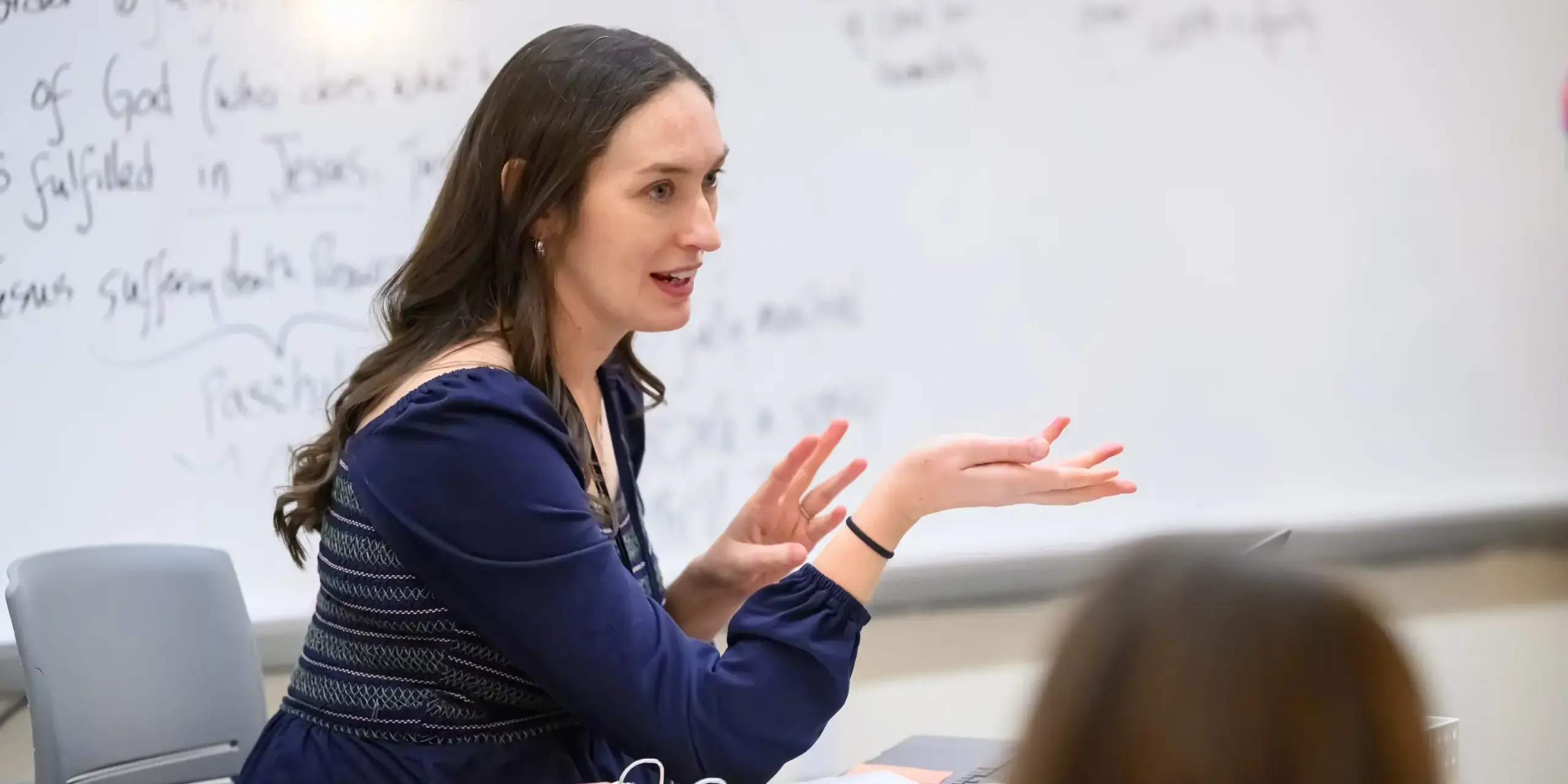
At Montrose, we are committed to engaging our students with the beauty, intelligence, and fullness of the Catholic faith as revealed by the person of Jesus Christ. This academic presentation of the teaching of the Catholic Church is a valuable tool for students of all faith backgrounds to better understand the intellectual, moral and spiritual foundations of the classical Western civilization. Courses in Religion, Theology, and Philosophy seek to help students learn what God has revealed of Himself, to know this revelation both through the use of their natural reason and through faith, and thereby to understand that faith and reason complement rather than contradict each other. Classes have regularly scheduled visits to the Our Lady Queen of the Angels Chapel and the opportunity to receive the Sacrament of Penance.
All students take a class in this department every year - Religion in 6th, 7th, and 8th grades, Theology in 9th and 10th grades, and Philosophy/Theology in 11th and 12th grades.
OUR THEOLOGY & PHILOSOPHY DEPARTMENT OFFERINGS
| RELIGION 6: THE CREED |
|---|
|
The first course in the Middle School religion sequence focuses on Christian Doctrine. Students find meaning in St. John Paul II’s statement that “Jesus Christ walks alongside each person as a friend” as they explore the truths and beliefs of the Catholic faith. They have the opportunity to study creation by the God of heaven and earth, the life journeys of the fathers of the faith, the coming of Jesus Christ, the Messiah and Son of God, and His message of love. Students learn and come to understand the twelve basic doctrines of the Catholic faith, all of which are contained in the Apostles Creed. |
| RELIGION 7: THE COMMANDMENTS |
|
The Commandments course invites students to explore who God is and how deeply he loves each person. Through Scripture, the Ten Commandments, the Beatitudes, the Works of Mercy, and the Theology of the Body, students will consider questions such as: How do we know what is true? Why do we need law? Can we experience joy even in times of suffering? Students study the life, death, and Resurrection of Jesus, and learn from the witness of the saints. Socratic seminars help students read and interpret texts, and connect what they learn with how they live. Together, we explore the beauty of creation and consider how truth, goodness, and beauty lead us toward God and our call to holiness. |
| RELIGION 8: SALVATION HISTORY |
|
Salvation History explores the story of God’s relationship with creation, from the beginning of Scripture to its fulfillment in Jesus Christ. Through close reading of Scripture, discussion, and reflection, students consider how, in the words of St. Augustine, “the New Testament is concealed in the Old, and the Old is revealed in the New.” Students study the structure and literary forms of the Bible, the Old Testament figures and covenants, and the history of Israel. They examine how God’s promise of salvation is fulfilled through the Incarnation, death and Resurrection of Jesus. They discover God as a communion of persons, encounter biblical figures with imagination and empathy, recognize how Old Testament events and people point toward Christ, and grow in understanding of God’s goodness and saving love. |
| Theology 9: Encountering Christ and the Sacramental Life |
|
This course presents the life, death, and Resurrection of Jesus Christ, the fulfillment of God’s eternal design, as revealed in Sacred Scripture and the Tradition of the Catholic Church. Through a robust synthesis of excerpts from the Catechism, Scripture, magisterial documents and the wisdom of the saints, students are challenged to come to a deeper encounter with Christ Himself. In the second semester, students focus their inquiry on the encounters through which the graces of Christ are dispensed in the Catholic Church: the seven sacraments. The course encourages students not only to recognize the Church’s sacraments but also to cultivate a sacramental understanding of the world, through which all of God’s creation can be understood as a communication of his divine love. |
|
Theology 10: Exploring the Rational Foundations of Faith |
|
This course explores the compelling and rigorous field of apologetics. Using a systematic examination of philosophical arguments and theological principles alongside concepts from the study of logic, students discover the rational foundations of the Catholic faith. Students build the skills necessary to articulate Christian doctrine in a reasoned and respectful manner, understanding that reflection and personal ownership strengthen faith. This course dives into the Catholic response to the important and difficult moral issues of our time, focusing not simply on what the Catholic Church teaches, but delving deeply into the reasons why these teachings developed. Students then study other world religions, knowing that an understanding of differing practices and beliefs helps us to interface thoughtfully with the modern world and to uncover how the universal principles underlying Christian anthropology intersect with other faiths. |
| Theology & Philosophy 11: THE Anthropology of the Human Person |
|
This course is designed to provide students with the philosophical and theological concepts required to understand the ethics of human flourishing and what it means to be human. Philosophy within the Christian context is often referred to as the handmaid of theology, and the first half of this course seeks to employ it as such. Students will engage with the primary texts of classical and Christian thinkers who were deeply concerned with the question of how best to live. |
| Theology/Philosophy 12: Capstone - EMBRACING Big Questions for Human Flourishing |
|
This required course helps students engage philosophically and theologically with the questions: Who am I?, What is my noble purpose?, and How am I being called to transform the world for good? Building on the study of human anthropology in 11th grade, in this Capstone class, students deeply examine the connection between anthropology and ethics. First, students examine social responsibility as an essential dimension of Christian anthropology and explore how Catholic Social Teaching is based in Christian anthropology. Then, students are introduced to alternate anthropologies in modern and contemporary philosophy and examine their social consequences. Ultimately, each student completes a Capstone project in which she deeply examines the philosophical roots of a social problem in her field of interest and proposes solutions that honor human dignity. Throughout the year, Pope Leo XIII’s encyclical Magnifica Humanitas serves as an anchor text to exemplify how Catholic Social Teaching and its underlying anthropology can speak to specific social challenges of our time. |
Imagine yourself here . . .
Whether in Religion, Theology, or Philosophy & Theology, you’ll encounter wonder before creation that speaks of its Creator as you delve into the beauty and intelligibility of the teachings of the Catholic Church. At every grade, you’ll reflect on life’s most important questions: What does it mean to be a human person, a unique and unrepeatable gift? What is the gift of love that is both your origin and your vocation? How do you choose well so that you and others can flourish?
Your studies will help you:
- Develop a philosophical mindset, asking probing questions and reading Biblical, classical, and contemporary texts, from Plato and Aristotle to Viktor Frankl and Immaculée Ilibagiza.
- Explore the Catholic faith in light of the broader Judeo-Christian tradition, engaging the fullness of your reason and imagination.
- Write and speak with clarity and charity as you build strong thinking skills.
- Access opportunities to engage with the Catholic faith through daily Mass, confession, spiritual direction, monthly adoration, and quiet time in the chapel of Our Lady of the Angels, open throughout the day.
Your education in this department culminates in a 12th grade Capstone project in which you’ll research a contemporary issue and analyze that issue in light of Catholic Social Teaching principles. You will graduate with a mind and habits formed in the Catholic Intellectual Tradition, a heart open to wonder, and a voice ready to enrich the world.
Theology & Philosophy Faculty
M.L.A., Concentration in Psychology, Harvard Extension School
M.A., Character Education, University of Birmingham (UK)
M.A., Philosophy and Education, Columbia University
Ph.D., Philosophy and Education, Columbia University
M.Ed., Northeastern University